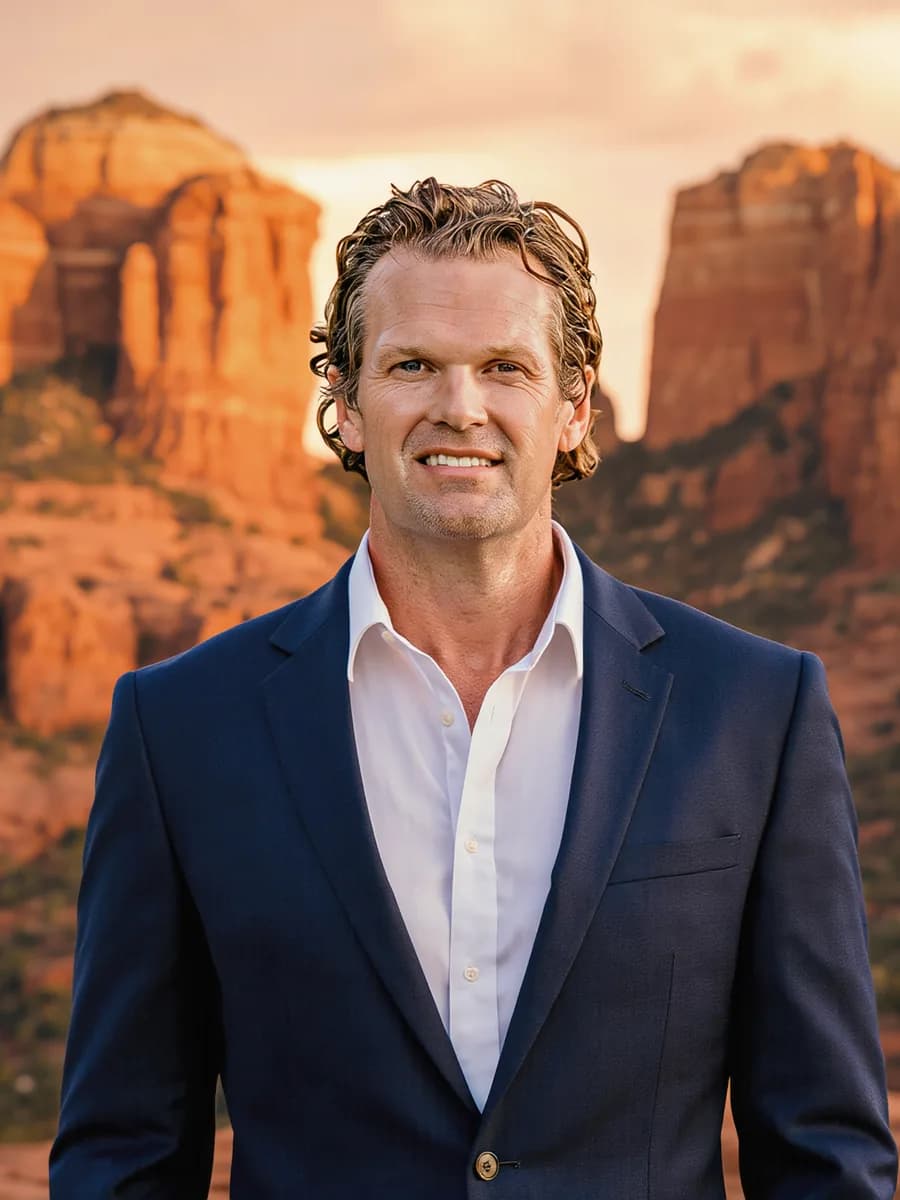
What a prosecutor's training actually contributes to an injury claim — and the verified background of the attorney who handles every Beam Injury Law case.
No legal fees unless we win · Serving all of Arizona
Beam Injury Law's attorney, Henry Beam, is a former prosecutor who now represents injured people across Arizona. He began his legal career as a Deputy County Attorney in Mohave County, prosecuting criminal cases, then spent two years at the Maricopa County Public Defender's Office before founding Beam Law, PLC in 2012. The firm is a solo practice based in Tempe that handles personal injury claims statewide on a contingency basis — clients speak with Henry directly, and there is no legal fee unless the case results in a recovery.
Criminal prosecution and personal injury law are different practices, but the underlying skill — proving what happened with evidence that survives challenge — is the same. Five things the prosecutor's role teaches, none of which is a substitute for the facts of a case:
Prosecutors are accountable for every piece of evidence from the moment it is collected. That means knowing how evidence is gathered, logged, and preserved — and recognizing when a gap in that chain will be used to challenge it. In an injury claim, the same discipline applies to vehicle data, photographs, surveillance video, and medical records.
A crash report is written by an officer under time pressure, and it is often incomplete. Prosecutors work from these reports daily and learn to separate observation from opinion, spot where the diagram and narrative conflict, know what a supplemental report adds, and recognize when a reconstruction expert is needed to establish speed, sightlines, or point of impact.
A prosecutor's work happens in and out of court — filings, hearings, motions, and deadlines, week after week. That teaches how judges rule on what evidence comes in, how a case moves through the system, and what a file must contain before it is ever filed. Injury claims are prepared with that process in mind, even though most resolve by settlement.
Insurance adjusters and defense attorneys evaluate a claim in part by how it is built. A file assembled with prosecutorial rigor — documented, organized, every element of liability and damages supported — reads differently from a demand letter with holes in it, and it shapes how seriously the claim is evaluated.
Beyond the crash report, a case may turn on 911 audio, computer-aided dispatch logs, body-camera or dash-camera footage, citation outcomes, and DUI or reckless-driving charges running parallel to the civil claim. A former prosecutor knows these records exist, who holds them, how to request them, and how a criminal case can affect the civil one.
Henry Beam started his legal career as a Deputy County Attorney in Mohave County, prosecuting criminal cases and learning the system from the inside. He then spent two years at the Maricopa County Public Defender's Office, representing people the system had already decided against. He founded Beam Law, PLC in 2012 and has spent 17+ years in Arizona courts — first as a prosecutor, then a public defender, now on the plaintiff's side. His experience includes deposition, mediation, and arbitration. Beam Injury Law is a solo practice: when a client hires Henry, they work with Henry.
Bar admissions
State Bar of Arizona #026708 · U.S. District Court of Arizona (2010)
Professional memberships
Arizona Association for Justice · American Association for Justice · Maricopa County Bar Association · State Bar of Arizona, Tort and Insurance Law Section
Full profile, education, and client reviews: Henry Beam, Founding Attorney.
The prosecutor background explains how a Beam Injury Law file gets built. It is not the main reason clients choose the firm. That reason is simpler: when someone calls, they talk to the attorney handling their case — not a phone tree, not a paralegal, not an associate. Henry Beam handles every consultation, every update, and every question himself.
That is the point of a solo practice. At a large firm an injured person is a file number moving between departments. Here, the lawyer who took the first call is the one who knows the medical records, negotiates with the adjuster, and answers the phone six months later. The firm serves clients statewide — by phone, by video, and in person anywhere in Arizona.
Real settlements, prepared like trials — by a lawyer who started his career prosecuting cases.
Uninsured Motorist
Pre-trial recovery for client struck by an uninsured driver. Pursued claim through client's own UM coverage.
Auto Accident
Client suffered multiple injuries in a vehicle collision. Settlement covered medical bills and lost wages.
Past results do not guarantee a similar outcome. Every case is different. Results listed include cases where Henry Beam served as lead or co-lead counsel.
No upfront fees. No legal fees unless we recover money for you.
We'll get back to you as soon as possible.
(480) 899-9019 — free consultation
An Arizona personal injury claim moves through predictable stages. At each one, the work is evidentiary — and that is where a prosecution background shows up in practice.
Investigation and evidence preservation
The first weeks decide what evidence will exist later. Preservation letters go to the at-fault driver's insurer and any business with cameras; vehicle event-data, phone records, and witness statements are secured before they disappear. This is the stage where a prosecutor's habit of locking down evidence early pays off most.
Records and reports
The crash report, supplemental reports, 911 and dispatch records, medical records, and billing are gathered and cross-checked. Inconsistencies between the officer's narrative and the physical evidence are identified now, not after the insurer raises them.
Liability and damages analysis
Arizona applies pure comparative negligence (ARS § 12-2505): an injured person's recovery is reduced by their percentage of fault. Each element — duty, breach, causation, and damages — is documented the way a prosecutor documents each element of an offense, because the other side will test every one.
Demand and negotiation
Once treatment has stabilized, a demand package presents liability and damages with supporting records. Henry Beam's experience includes deposition, mediation, and arbitration — the settings where most Arizona injury claims are actually resolved.
Litigation when needed
If the insurer will not resolve the claim fairly, a lawsuit is filed in the Arizona Superior Court before the two-year deadline in ARS § 12-542. Discovery, depositions, and motion practice are governed by the same rules of evidence and procedure a prosecutor works under every day.
A former prosecutor is still bound by the same law as every other Arizona attorney. The background does not change the two-year filing deadline, the comparative fault rule, the available insurance coverage, or the facts of the crash. No attorney's history determines the outcome of a claim, and Arizona ethics rules prohibit lawyers from promising results.
What it does change is how the claim is built: which evidence is gathered first, how records are read, and how the file is prepared for the scrutiny it will receive from an adjuster, a defense attorney, or a judge. The goal is full and fair compensation supported by proof — not a promise about the result.
If a Government Entity Was Involved — Shorter Deadlines Apply
When the at-fault party may be a government entity — a city or county, a public school, a state agency, ADOT, a police or sheriff department, a public hospital, or a government-owned road or vehicle — Arizona imposes two deadlines that are much shorter than the general two-year period:
Missing the 180-day notice typically bars the claim entirely, regardless of how strong the case is. Early legal review helps identify whether a government defendant applies and protects both deadlines.
A free consultation by phone or video, with the attorney who will handle the case. No legal fees unless we win.